$$\newcommand{\mtn}{\mathbb{N}}\newcommand{\mtns}{\mathbb{N}^*}\newcommand{\mtz}{\mathbb{Z}}\newcommand{\mtr}{\mathbb{R}}\newcommand{\mtk}{\mathbb{K}}\newcommand{\mtq}{\mathbb{Q}}\newcommand{\mtc}{\mathbb{C}}\newcommand{\mch}{\mathcal{H}}\newcommand{\mcp}{\mathcal{P}}\newcommand{\mcb}{\mathcal{B}}\newcommand{\mcl}{\mathcal{L}} \newcommand{\mcm}{\mathcal{M}}\newcommand{\mcc}{\mathcal{C}} \newcommand{\mcmn}{\mathcal{M}}\newcommand{\mcmnr}{\mathcal{M}_n(\mtr)} \newcommand{\mcmnk}{\mathcal{M}_n(\mtk)}\newcommand{\mcsn}{\mathcal{S}_n} \newcommand{\mcs}{\mathcal{S}}\newcommand{\mcd}{\mathcal{D}} \newcommand{\mcsns}{\mathcal{S}_n^{++}}\newcommand{\glnk}{GL_n(\mtk)} \newcommand{\mnr}{\mathcal{M}_n(\mtr)}\DeclareMathOperator{\ch}{ch} \DeclareMathOperator{\sh}{sh}\DeclareMathOperator{\th}{th} \DeclareMathOperator{\vect}{vect}\DeclareMathOperator{\card}{card} \DeclareMathOperator{\comat}{comat}\DeclareMathOperator{\imv}{Im} \DeclareMathOperator{\rang}{rg}\DeclareMathOperator{\Fr}{Fr} \DeclareMathOperator{\diam}{diam}\DeclareMathOperator{\supp}{supp} \newcommand{\veps}{\varepsilon}\newcommand{\mcu}{\mathcal{U}} \newcommand{\mcun}{\mcu_n}\newcommand{\dis}{\displaystyle} \newcommand{\croouv}{[\![}\newcommand{\crofer}{]\!]} \newcommand{\rab}{\mathcal{R}(a,b)}\newcommand{\pss}[2]{\langle #1,#2\rangle} $$
Bibm@th
Lien copié  ✅

Ludwig Bieberbach (4 décembre 1886 [Goddelau, Hesse] - 1er septembre 1982 [Oberaudorf, Bavière])
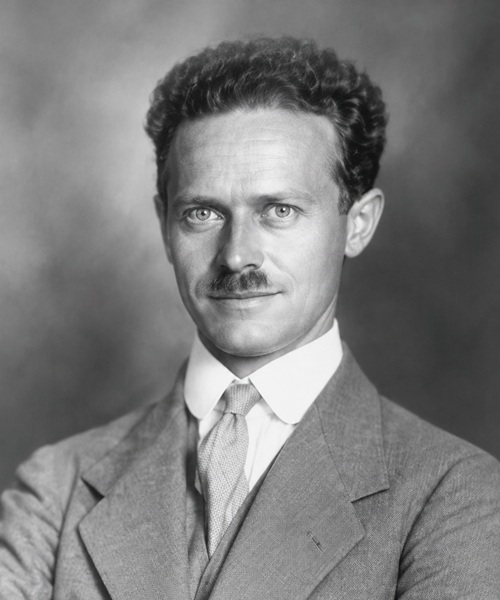
Ludwig Bieberbach est un mathématicien allemand du XXè siècle à l'image entachée par son ralliement au nazisme. Il né le 4 décembre 1886 à Goddelau, dans le grand-duché de Hesse, d'un père médecin. Après des études à Heidelberg puis à Göttingen, il soutient en 1910, sous la direction de Klein, une thèse sur les fonctions automorphes.

Cette même année, il acquiert une réputation internationale en résolvant la première partie du dix-huitième problème de Hilbert : il établit que, dans un espace euclidien de dimension quelconque, il n'existe qu'un nombre fini de groupes de déplacements essentiellement distincts, autrement dit de groupes cristallographiques. Après un passage à Königsberg auprès de Schönflies, il est nommé professeur à Bâle en 1913, puis à Francfort en 1915, et enfin à Berlin à partir de 1921 ; il épouse en 1914 Johanna Stoermer, avec qui il aura quatre fils.

C'est à Francfort qu'il énonce, en 1916, la conjecture qui l'a rendu célèbre : si la série entière $$f(z)=z+\sum_{n\geq 2}a_n z^n$$ définit une fonction holomorphe et injective sur le disque unité, alors $|a_n|\leq n$ pour tout $n\geq 2.$ Il prouve lui-même le cas $n=2$ et cette conjecture sera l'un des plus célèbres problèmes de l'analyse complexe du XXè siècle avant sa résolution par de Branges en 1984.

En 1933, il se rallie aux idées nazistes. Il participe avec ses quatre fils à une marche des SA, adhère au parti en 1937, se présente en uniforme à des examens et professe un cours intitulé « Les grands mathématiciens allemands, approche par les races ». Il fonde la revue Deutsche Mathematik, où il oppose une prétendue mathématique « allemande », intuitive et synthétique, à une mathématique « juive », abstraite et analytique. Il soutient les exclusions de ses collègues juifs des universités, dont Edmund Landau et Issai Schur.

En 1945, Bieberbach est démis de toutes ses fonctions, arrêté et frappé d'une interdiction durable d'enseigner en Allemagne. Il continue ensuite d'écrire des manuels estimés, sur les constructions géométriques (1952) ou les équations différentielles (1953, 1956), et meurt le 1er septembre 1982 à Oberaudorf, en Bavière.

L'image illustrant cette biographie est issue du site MacTutor et à été retouchée par IA.

Les entrées du Dicomaths correspondant à Bieberbach

Les mathématiciens contemporains de Bieberbach (né en 1886)
  • Pavel Alexandrov (né en 1896)
  • Emil Artin (né en 1898)
  • René Baire (né en 1874)
  • Stefan Banach (né en 1892)
  • Félix Bernstein (né en 1878)
  • Serguei Bernstein (né en 1880)
  • Arne Beurling (né en 1905)
  • George David Birkhoff (né en 1884)
  • Harald Bohr (né en 1887)
  • Émile Borel (né en 1871)
  • Luitzen Egbertus Jan Brouwer (né en 1881)
  • Constantin Carathéodory (né en 1873)
  • Elie Cartan (né en 1869)
  • Henri Cartan (né en 1904)
  • André-Louis Cholesky (né en 1875)
  • Richard Courant (né en 1888)
  • Georges De Rham (né en 1903)
  • Paul Dirac (né en 1902)
  • Pierre Fatou (né en 1878)
  • Lipót Fejér (né en 1880)
  • Ronald Aylmer Fisher (né en 1890)
  • Abraham Fraenkel (né en 1891)
  • Maurice Fréchet (né en 1878)
  • Guido Fubini (né en 1879)
  • René Gateaux (né en 1889)
  • Thomas Hakon Grönwall (né en 1877)
  • Hans Hahn (né en 1879)
  • Georg Hamel (né en 1877)
  • Godfrey Harold Hardy (né en 1877)
  • Félix Hausdorff (né en 1868)
  • Heinz Hopf (né en 1894)
  • Gaston Julia (né en 1893)
  • Andreï Kolmogorov (né en 1903)
  • Edmund Landau (né en 1877)
  • Henri Lebesgue (né en 1875)
  • Solomon Lefschetz (né en 1884)
  • Paul Lévy (né en 1886)
  • John Littlewood (né en 1885)
  • Szolem Mandelbrojt (né en 1899)
  • Paul Montel (né en 1876)
  • Louis Mordell (né en 1888)
  • John von Neumann (né en 1903)
  • Rolf Nevanlinna (né en 1895)
  • Emmy Noether (née en 1882)
  • Alessandro Padoa (né en 1868)
  • Michel Plancherel (né en 1885)
  • George Pólya (né en 1887)
  • Emil Leon Post (né en 1897)
  • Srinivasa Ramanujan (né en 1887)
  • Frigyes Riesz (né en 1880)
  • Bertrand Russell (né en 1872)
  • Erhard Schmidt (né en 1876)
  • Issai Schur (né en 1875)
  • Waclaw Sierpiński (né en 1882)
  • Hugo Steinhaus (né en 1887)
  • Marshall Stone (né en 1903)
  • Teiji Takagi (né en 1875)
  • Otto Toeplitz (né en 1881)
  • Pavel Urysohn (né en 1898)
  • Hermann Weyl (né en 1885)
  • Norbert Wiener (né en 1894)
  • Oscar Zariski (né en 1899)
  • Ernst Zermelo (né en 1871)