


Fonctions usuelles
La fonction exponentielle
- Théorème et définition : Il existe une unique fonction $f:\mathbb R\to\mathbb R$ dérivable, vérifiant $f'=f$ et $f(0)=1$. On appelle cette fonction la fonction exponentielle et on la note $\exp$.
- Proposition : La fonction exponentielle est toujours strictement positive.
- En particulier, puisque $(\exp)'=\exp$, on déduit de la proposition précédente que la fonction exponentielle est strictement croissante sur $\mathbb R$.
- Proposition (relation fonctionnelle de la fonction exponentielle) : Soit $x,y\in\mathbb R$. Alors on a $\exp(x+y)=\exp(x)\exp(y)$. En particulier, on a $\exp(-x)=\frac 1{\exp x}.$
- Proposition (limite aux bornes et croissance comparée) : On a $\lim_{x\to+\infty}\exp(x)=+\infty$ et $\lim_{x\to-\infty}\exp(x)=0$. De plus, pour tout $n\in\mathbb N$, on a $$\lim_{x\to+\infty}\frac{e^x}{x^n}=+\infty\textrm{ et }\lim_{x\to-\infty}x^n e^{x}=0.$$

La fonction logarithme népérien
- Théorème et définition : La fonction exponentielle réalise une bijection de $\mathbb R$ sur $]0,+\infty[$ : pour tout $y>0$, il existe un unique $x\in \mathbb R$ tel que $e^x=y$. On appelle $x$ le logarithme népérien de $y$ et on note $x=\ln(y)$.
- Proposition (relation fonctionnelle de la fonction logarithme) : Soit $x,y>0$. On a $\ln(x\cdot y)=\ln(x)+ \ln(y)$. En particulier, on a $\ln\left(\frac 1x\right)=-\ln (x)$.
- Théorème : La fonction logarithme est dérivable sur $]0,+\infty[$ et pour tout $x>0$,on a $(\ln )'(x)=\frac 1x$.
- On tire de la proposition précédente ou du fait que la réciproque d'une fonction strictement croissante est strictement croissante que le logarithme népérien est strictement croissant sur $]0,+\infty[$.
- Proposition (limite aux bornes et croissance comparée) : On a $\lim_{x\to+\infty}{\ln x}=+\infty$ et $\lim_{x\to 0}\ln x=-\infty$. De plus, pour tout $n\geq 1$, on a $\lim_{x\to+\infty}\frac{\ln x}{x^n}=0$ et $\lim_{x\to 0}x^n\ln(x)=0$.
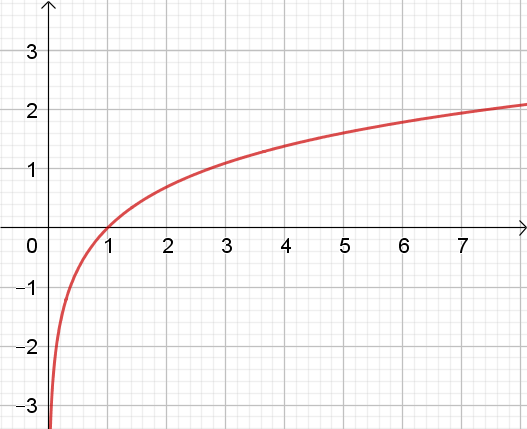
- On définit également le logarithme de base $a>0$ par $\log_a(x)=\frac{\ln x}{\ln a}$ et l'exponentielle de base $a$ par $a^x=\exp(x\ln a)$. L'étude de ces fonctions se ramène immédiatement à l'étude des fonctions logarithme et exponentielle.
Fonctions puissance- Définition : pour $\alpha\in\mathbb R$, $x^\alpha=\exp(\alpha \ln x)$;
- Domaine de définition : $\mathbb R_+^*$, sauf si $\alpha$ est un entier naturel. Dans ce cas, le domaine de définition est $\mathbb R$.
- Dérivée : $\alpha x^{\alpha-1}$;
- Sens de variation : croissante si $\alpha>0$, décroissante si $\alpha<0$, constante si $\alpha=0$.
- Limites aux bornes :
- si $\alpha>0$, alors $\lim_{x\to 0}x^\alpha=0$ et $\lim_{x\to+\infty}x^\alpha=+\infty$;
- si $\alpha<0$, alors $\lim_{x\to 0}x^\alpha=+\infty$ et $\lim_{x\to+\infty}x^\alpha=0$;
- Propriétés algébriques : pour tous $\alpha,\beta\in\mathbb R$, pour tout $x>0$, on a $$(xy)^\alpha=x^\alpha y^\alpha,\ x^{\alpha+\beta}=x^\alpha x^\beta,\ (x^\alpha)^\beta=x^{\alpha\beta}.$$
- Courbe représentative :

Fonctions sinus, cosinus, tangenteNom sinus cosinus tangente Notation $\sin x$ $\cos x$ $\tan x$ Départ et
arrivée$\mathbb R\to[-1,1]$ $\mathbb R\to[-1,1]$ $\mathbb R\backslash\{\frac\pi2+k\pi,\ k\in\mathbb Z\}\to\mathbb R$ Parité Impaire Paire Impaire Période $2\pi$ $2\pi$ $\pi$ Dérivée $\cos x$ $-\sin x$ $1+\tan^2 x=\frac 1{\cos^2 x}$ Monotonie Croissante sur $[-\pi/2,\pi/2]$ Décroissante sur $[0,\pi]$ Croissante sur $]-\pi/2,\pi/2[$ Courbe
représentative

 Fonctions arcsin, arccosinus, arctangente
Nom arcsinus arccosinus arctangente Notation $\arcsin x$ $\arccos x$ $\arctan x$ Départ et
arrivée$[-1,1]\to[-\pi/2,\pi/2]$ $[-1,1]\to[0,\pi]$ $\mathbb R\to ]–\pi/2,\pi/2[$ Lien avec les
fonctions circulaires$\small y=\arcsin x\iff \left\{ \begin{array}{l} x=\sin y\\ y\in\left[\frac{-\pi}2,\frac\pi2\right] \end{array}\right.$ $\small y=\arccos x\iff \left\{ \begin{array}{l} x=\cos y\\y\in[0,\pi] \end{array}\right.$ $\small y=\arctan x\iff \left\{ \begin{array}{l} x=\tan y\\y\in\left]\frac{-\pi}2,\frac\pi2\right[ \end{array}\right.$ Parité Impaire Ni paire, ni impaire Impaire Dérivée $\frac 1{\sqrt{1-x^2}}$ $-\frac 1{\sqrt{1-x^2}}$ $\frac1{1+x^2}$ Monotonie Croissante Décroissante Croissante Limites Sans objet Sans objet $\lim_{x\to+\infty}\arctan x=\frac\pi2$ Courbe
représentative


Formules $\forall x\in [-1,1], \arccos x+\arcsin x=\frac\pi 2$ $\small \forall x> 0,\ \arctan x+\arctan\frac 1x=\frac\pi2.$ Fonctions sinus hyperbolique, cosinus hyperbolique, tangente hyperboliqueNom sinus hyperbolique cosinus hyperbolique tangente hyperbolique Définition $\sh x=\frac{e^x-e^{-x}}2$ $\ch x=\frac{e^x+e^{-x}}2$ $\th x=\frac{\sh x}{\ch x}=\frac{e^x-e^{-x}}{e^x+e^{-x}}$ Départ et
arrivée$\mathbb R\to\mathbb R$ $\mathbb R\to [1,+\infty[$ $\mathbb R\to]-1,1[$ Parité Impaire Paire Impaire Dérivée $\ch x$ $\sh x$ $1-\th^2 x=\frac 1{\ch^2 x}$ Monotonie Croissante Croissante sur $\mathbb R_+$ Croissante Limites $\lim_{x\to+\infty}\sh x=+\infty$ $\lim_{x\to+\infty}\ch x=+\infty$ $\lim_{x\to+\infty}\th x=1$ Courbe
représentative


Formules $\ch^2(x)-\sh^2(x)=1$