


Formulaire de Mathématiques : Table de la loi du chi-deux
Utilisation
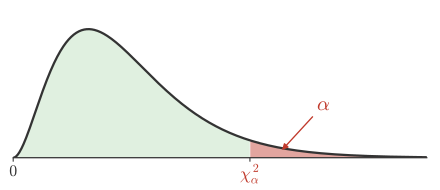
Soit ${X}$ une variable aléatoire qui suit la loi du ${\chi^2}$ à ${\nu}$ degrés de liberté (ddl). En fonction de ${\nu}$ (en ligne) et d'une probabilité ${\alpha}$ (en colonne), la table donne le réel ${\chi^2_\alpha}$ tel que $$P(X>\chi^2_\alpha)=\alpha.$$
Table
| ${\nu}$ | 0,10 | 0,05 | 0,01 | 0,001 |
|---|---|---|---|---|
| 1 | 2,706 | 3,841 | 6,635 | 10,828 |
| 2 | 4,605 | 5,991 | 9,210 | 13,816 |
| 3 | 6,251 | 7,815 | 11,345 | 16,266 |
| 4 | 7,779 | 9,488 | 13,277 | 18,467 |
| 5 | 9,236 | 11,070 | 15,086 | 20,515 |
| 6 | 10,645 | 12,592 | 16,812 | 22,458 |
| 7 | 12,017 | 14,067 | 18,475 | 24,322 |
| 8 | 13,362 | 15,507 | 20,090 | 26,124 |
| 9 | 14,684 | 16,919 | 21,666 | 27,877 |
| 10 | 15,987 | 18,307 | 23,209 | 29,588 |
| 11 | 17,275 | 19,675 | 24,725 | 31,264 |
| 12 | 18,549 | 21,026 | 26,217 | 32,909 |
| 13 | 19,812 | 22,362 | 27,688 | 34,528 |
| 14 | 21,064 | 23,685 | 29,141 | 36,123 |
| 15 | 22,307 | 24,996 | 30,578 | 37,697 |
| 16 | 23,542 | 26,296 | 32,000 | 39,252 |
| 17 | 24,769 | 27,587 | 33,409 | 40,790 |
| 18 | 25,989 | 28,869 | 34,805 | 42,312 |
| 19 | 27,204 | 30,144 | 36,191 | 43,820 |
| 20 | 28,412 | 31,410 | 37,566 | 45,315 |
| 21 | 29,615 | 32,671 | 38,932 | 46,797 |
| 22 | 30,813 | 33,924 | 40,289 | 48,268 |
| 23 | 32,007 | 35,172 | 41,638 | 49,728 |
| 24 | 33,196 | 36,415 | 42,980 | 51,179 |
| 25 | 34,382 | 37,652 | 44,314 | 52,620 |
| 30 | 40,26 | 43,77 | 50,89 | 59,70 |
| 35 | 46,06 | 49,80 | 57,34 | 66,62 |
| 40 | 51,81 | 55,76 | 63,69 | 73,40 |
| 45 | 57,51 | 61,66 | 69,96 | 80,08 |
| 50 | 63,17 | 67,50 | 76,15 | 86,66 |
| 60 | 74,40 | 79,08 | 88,38 | 99,61 |
| 70 | 85,53 | 90,53 | 100,43 | 112,32 |
| 80 | 96,58 | 101,88 | 112,33 | 124,84 |
| 90 | 107,57 | 113,15 | 124,12 | 137,21 |
| 100 | 118,50 | 124,34 | 135,81 | 149,45 |
| ${\nu}$ | 0,10 | 0,05 | 0,01 | 0,001 |
Remarques
- Exemple : pour ${\nu=5}$ et ${\alpha=0{,}05}$, on lit ${\chi^2_\alpha=11{,}070}$ (case entourée) : un dé à six faces est jugé truqué au seuil de ${5\,\%}$ si la statistique du ${\chi^2}$ d'adéquation dépasse ${11{,}070}$ (voir les tests statistiques).
- La loi du ${\chi^2}$ n'est pas symétrique : pour un intervalle de confiance sur une variance, il faut lire deux valeurs, ${\chi^2_{1-\alpha/2}}$ et ${\chi^2_{\alpha/2}}$ (voir la fiche estimation).
- Au-delà de ${100}$ degrés de liberté : ${\sqrt{2X}-\sqrt{2\nu-1}}$ suit approximativement la loi normale ${\mathcal N(0,1)}$.